
Hardware Development
Circuits and PCBs for your product
You need the electronics for your product, from a feasibility check to a tested prototype. We develop circuits and PCBs and support the hardware through all development steps.
We try to identify possible challenges in the early phase and address them, so that development stays efficient and cost-effective.
Deliverables
- Proof of concept: requirements, goals and feasibility
- Schematic, taking CE conformity and ESD protection into account
- Simulation of critical circuit sections, e.g. power transistors or low-power circuits
- Bill of materials and cost analysis including series price calculation
- PCB layout following EMC guidelines, coordinated with you or your design team
- Prototype assembly: components are ordered and assembled onto the boards in our electronics lab
- Test firmware and hardware tests of the prototypes
- Test equipment for the final inspection of series boards and customer-specific parameterization
Technical focus areas
- Analog and digital circuit design
- Microcontroller technology and sensing
- Power electronics and RF engineering
- Low-power and battery-operated circuits
Our approach
Hardware development follows this cycle: from proof of concept to test equipment and parameterization:
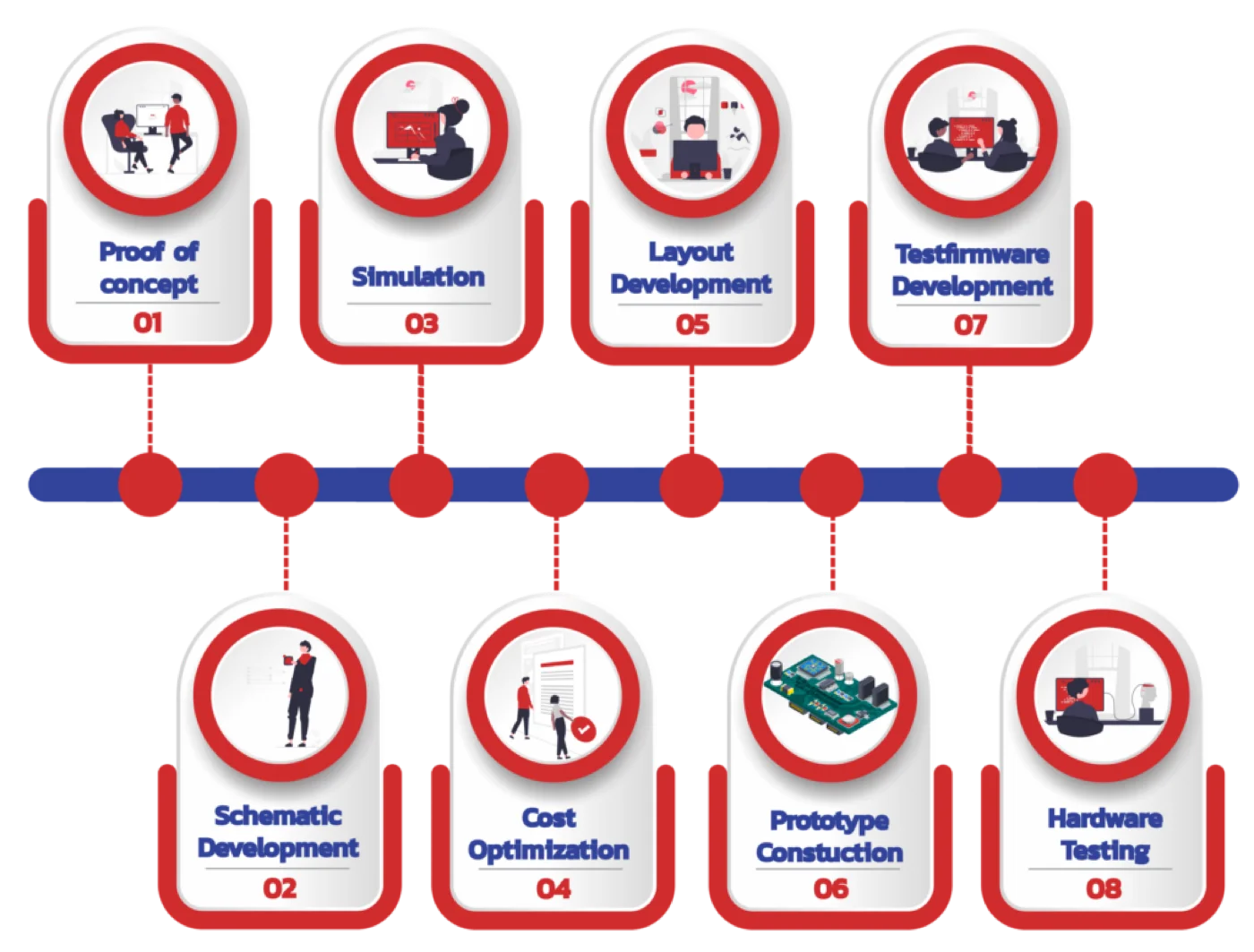
The eight phases in detail
Proof of Concept
At the beginning of every project, we initiate the proof of concept phase, during which the product's requirements and objectives are carefully defined. This phase lays the foundation for the design and further development by assessing feasibility and strategic direction.
Circuit Diagram Development
Using state-of-the-art CAD systems and an extensive component library, we develop precise circuit diagrams. These diagrams take into account not only technical aspects but also regulatory requirements such as CE compliance and ESD protection measures.
Simulation
Critical circuit components, such as power transistors or energy-efficient circuits for battery-operated devices, are simulated. This enables us to identify and address potential weaknesses early, well before the first prototypes are built.
Cost Optimization
After finalizing the circuit diagram, we create a detailed bill of materials and perform a cost analysis. These steps are crucial for budget optimization and the long-term maintainability of the products.
PCB Layout Design
The physical design of the PCB is carried out in strict adherence to EMC guidelines. The placement of connectors, buttons, and other interfaces is determined in close consultation with you or your design team.
Prototype Construction
Once all the preceding steps have been completed, we begin constructing the prototypes. The components are ordered and mounted on the PCBs in our electronics laboratory.
Test Firmware Development
The functionality of the prototypes is verified using specially developed test firmware and comprehensive hardware tests. These tests ensure that all components perform as intended and that the products meet the final requirements.
Hardware Testing
For the final testing of mass-produced PCBs, we develop specialized test equipment. This enables us to efficiently test the products and apply customer-specific configurations.
How a project runs from idea to handover is described on the development process page.